Friday, June 08, 2007

Craigslist blocks Listpic due to usage violation

I discovered Listpic a while back, I think linking to it from LifeHacker. In case you never got a chance to see it, Listpic analyzed Craigslist ads and created a gallery page from the ads that contained photos. It was great when we were looking for furniture, and it apparently came in handy for those who wanted to browse personal ads (a use-case that didn't occur to me).

Craigslist is a great site. Power to the people, grass roots movement, down with newspaper conglomerates and so on. But let's face it. The interface has never been great. I understand the effort is in keeping it lightweight, but Listpic performed a valuable function for me. It saved me time.

I'm never going to buy furniture--or a car, or a computer, or a Hummel Figurine--sight-unseen. I feel like anyone who wants to sell something online who gives half a whit about getting their junk out of their garage is going to attach a picture. If a seller can't be bothered to post one, I'm not going to bother looking at their ad. With Listpic, I could browse their Gallery of items listed on Craigslist and only click through to those posts that interested me, rather than looking in the Craigslist listings for the icon indicating that an ad contains pictures, then clicking through to each and every ad individually.

Browsing Craigslist proper, I wasted a lot of time looking at ads that I never would have clicked through to if I'd had a picture preview. Listpic let me take advantage of the the years of evolution responsible for the development of my visual cortex. Most humans with full use of their sight are much better at quickly scanning a group of photos than scanning separate lines of text. I always figured that Listpic was letting me evaluate more products than I ever would with the standard Craigslist interface.

Well today I learned from the Download Squad that Listpic has been blocked from accessing Craigslist due to what are known as Terms of Use violations. This means that Listpic is dark for the time being. It seems that Craigslist's justification for the blackout can be summed up in a few bullets:
  • Listpic uses ads. Craigslist doesn't, and their community is against the use of their content by other sites to generate revenue.
  • By scraping the ads and pictures from Craigslist, Listpic is leeching a significant amount of bandwidth that Craigslist has to pay for.
  • The Craigslist Terms of Use allow them to ban and fine(!) anyone who republishes or aggregates more than 100 ads without permission.
So let's state the obvious. Craigslist is completely within their rights here. It seems pretty clear that Ryan, the developer behind Listpic, probably didn't read the terms of use and probably didn't ask Craigslist if it was okay for him to reprint their ad content. That's just a dumb mistake. CYA, my friend.

But Craiglist is not handling this situation well, either. Ryan is claiming that he wasn't contacted before receiving the cease-and-desist letter from Craigslist. That seems to fly in the face of the informal, "rootsy" image that Craigslist cultivates. The backlash in the Craigslist forums also indicates that Listpic was providing a service a lot of people appreciated, and there's a lot of testimony that it contributed to people using Craigslist more than they had before. But apparently this is one sticking point: how many people use Listpic anyway, and how much of a bandwidth impact are they having?

In one response to the forum users calling for his head, Craigslist founder Craig Neumark states that the main reason for the shut down was bandwidth related: Listpic was using too much. But then, a few hours later, Craig says in a post that they can tell only a very few people use Listpic. Does this make sense? I'm not privy to traffic figures for Craigslist or Listpic, but this just doesn't pass the sniff test. Listpic has been around for at least 9 months, as the date on this post from the Consumerist proves. Has Listpic's bandwidth imposition happened so dramatically, and in such a short period that the Craigslist Server Admins have only just noticed that someone has been scraping their site, a few thousand images at a time? Maybe someone at Craigslist needs to hire new admins to monitor their web traffic (I am available, Craig...email me). Maybe it just took Craig and Co. a while to figure out what to do, but I find it hard to believe that no one at Craigslist knew what was going on. It's clearly not just about reprint rights or bandwidth usage, or even advertising. All of these things have been going on for 9 months, with nary a peep from Craigslist.

Just out of curiosity, I looked up the Craigslist TOS statement on Archive.org, to see if there was anything hinky going on....maybe Ryan was caught unawares with an unannounced update to the TOS. I'm not accusing Craigslist of changing the TOS just because of Listpic, but I find it interesting that the last version of the Craigslist TOS at Archive.org doesn't mention the $3000 per day fines that the cease-and-desist letter does. In fact, that version of the TOS--logged by Archive.org on Dec. 26th, 2005--doesn't even have a section 19(f), which outlines the fines Ryan may be faced with.

That's not to say that Ryan's off the hook. Even in 2005, you couldn't use Craigslist ads without permission. Oops.

Listpic was a great idea. Craig says that a major problem they had with Listpic was the monetization of Craigslist content through web advertising. Maybe that's not okay according to the terms of use, but it's an idea very much in the 'spirit' of web 2.0. Google uses their index of web content to provide search results, and then display ads relating to those results. This is a leveraging of other people's content to gain revenue. Sure, if I run my own web server, I can tell Google that their bots aren't welcome, but Google doesn't ask permission before they index sites. They assume that if you aren't blocking them, you're okay with their use of your site's content. Interestingly enough, though, Google has realized that having people use their tools in innovative ways only adds value to what they do. The give-back from Google for the use of all that web content comes in the form of all the open APIs that Google allows other people to use, for free. Those are the tools that make all those neat Google Maps mashups possible. There would be no Listpic without Craigslist, but Listpic was giving back to the Craigslist community. This sounds like a very symbiotic relationship, and one that made it a lot easier for the community to access its own content.

Here's how to remedy this situation. Ready your pencils, lawyers and executives.

Craigslist should integrate the Listpic functionality. If it's too much of a bandwidth hog, make it only available to paid members, and continue to offer the lightweight version for non-paying users. Ryan has some prior art in the graphical display of Craigslist ads, so I feel its only fair to offer him some sort of deal. If he's a good coder, then offer him a job. If that's not feasible, then maybe Craig can license or outright buy the Listpic code. Oh, and Ryan, if Craigslist fines you (or deducts that amount from any contracts), pay up and don't complain. Next time, you'll read the fine print and ask permission.

Finally, Craigslist should reconsider its policy regarding usage of ad content, especially when it clearly adds value for the communities of past and future Craigslist users. Craig Neumark says that the Craigslist community has decided that their ads shouldn't be used for revenue by outside sites. Well, everybody's gotta pay for their bandwidth. Craigslist is not a charity, and it's not like Listpic was a link farming site, reprinting Craigslist content and attaching ads to it without giving anything back. Listpic added something that the community found valuable, even if it was operating outside the terms of use. I think that it better serves the online community if people like Ryan, those with innovative ideas, are brought gently into the fold rather than threatened with blackouts and thousands of dollars in fines. Otherwise, Craigslist starts to look more like the coercive newspaper syndicates it has replaced than the user-centric community it purports to be.

Thursday, May 31, 2007

Moblogging...

Blogger supports posting via email and devices, I have discovered. So, here is a picture of pig neon.


Click here to visit the Lizard Robot MoBlog.

Monday, May 21, 2007

"Heroes" Season Finale Tonight!...

And in honor of that event, I'll post a link to a novelty gallery that captures the Heroes characters as Mii avatars on the Nintendo Wii console.

Click on Hiro below to link to the original article at IGN.com.


Enjoy the show!

Letter to the Editor...

I have had a letter to the editor published in the most recent InformationWeek, issue 1,139. My letter was written in response to an article in last week's IW, entitled "Message To Cell Carriers" (link goes to the original article). You can find a reprint of my letter as it appears in the magazine here, but the letter that they printed was edited a little for style and content. I'll post the original email that I sent IW here.
To: iweekletters@cmp.com, mediarelations@t-mobile.com
From: William Jones

Dear Editor,

I feel motivated to comment on the article printed in the May 14th issue of InformationWeek, Message to Cell Carriers, by Elena Malykhina and Richard Martin.

In their article, the authors miss the fact that the US Register of Copyrights recommended an exemption to the DMCA that allows customers to legally defeat provider locks on cell phones. The exemption took effect on November 27, 2006, and will be up for renewal in three years.

In order to put this new freedom to the test, I contacted T-Mobile to see if I could unlock the new BlackBerry Pearl I bought from Amazon. T-Mobile support responded that unlocking my BlackBerry was absolutely something they would help me with, once my account was 90 days old. All I had to do was ask.

I realize that handset subsidies are one of the major marketing tools available to carriers in the US wireless market, and I have no problem with my carrier asking me to wait a reasonable length of time before freeing my handset. In this case, T-Mobile's willingness to unlock my phone without giving me a hassle has earned them a loyal customer. I thought that this example of T-Mobile's effort to put customer service before restrictive business practices should be recognized, given that your article tends to paint all wireless carriers with the same unflattering brush. We should recognize when a wireless company is doing the "right" thing, if we want the industry to improve.

William Jones
Technology Coordinator
Chicago, IL
The frustrating thing is that the real point I was trying to make has been edited out of my letter before the mag went to press. Maybe this is because I did some pretty clear T-Mobile cheerleading there at the end; I can see why the editors might want to strike that bit for the sake of appearing more balanced. The problem is that the original article that I chose to respond to was pretty clearly biased against wireless carriers, laying most of the problems with the US industry at their feet. While the carriers are certainly culpable, a fundamental part of bringing corporate change through activism involves acknowledging--even praising!--a company when they show a positive shift in policy. A case where a major carrier like T-Mobile is willing to allow customers to unlock their handsets without any significant trouble undermines the implication made in the original article that the only way that cell providers can retain business is by restricting customers' freedom. I'll voluntarily stay with a company that treats me well, and so will most other people. That's the point of my letter: that we should encourage customer service as an alternative to retention policies grounded in customer lock-in. Because it can work.

Wednesday, May 16, 2007

Office Superfriends Space

Something my friend Nick sent me long ago which sprang from my email archive like a viper. It made me laugh today, as it did so many years ago. Here's to you Nick!

Tuesday, December 12, 2006

Welcome to the Sexy? -- Subliminal Marketing and the Microsoft Zune

As a long-time Macintosh user and a fan of Apple's iPod and iTunes software, I am not predisposed to having any affection for Microsoft's new digital audio player, the Zune. [Which is lucky for me, because the reviews are less than glowing.]

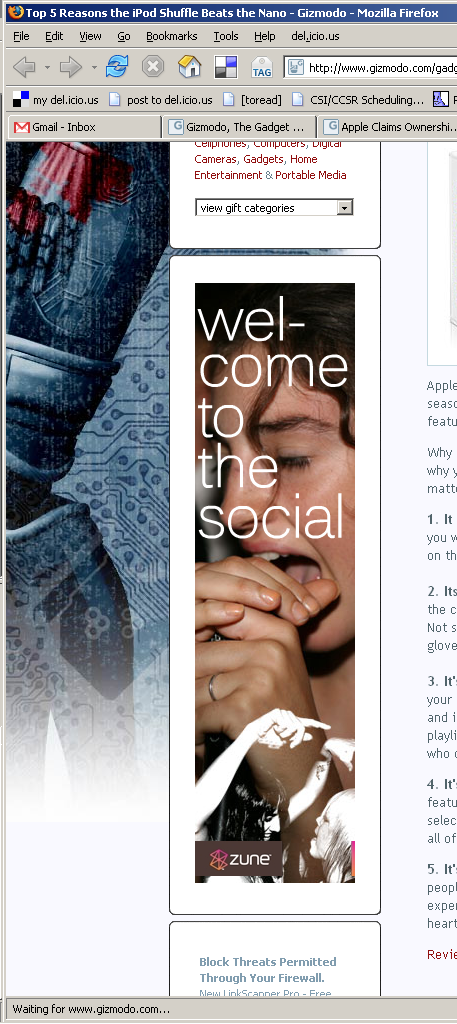
Microsoft certainly has a long hill to climb in order to challenge Apple's dominance of the digital audio market, but I saw something today that really showed me how far MS is willing to go. Anyone who regularly follows the expensive gadget scene is familiar with Microsoft's marketing slogan for the Zune, "Welcome to the Social", which tries to draw attention to the Zune's wireless (and DRM encumbered) music sharing features. Attempting to follow the "Sex Sells" axiom, is Microsoft leveraging a double entendre with the word "social"? Let's look at the banner ad I saw today while reading Gizmodo during lunch....

[These images are unretouched....I swear. Just cropped for clarity.]

Here's a small screenshot, for context.


The full size image follows your click below....


Is it my gutter, or is that photo of the nice young woman a bit...suggestive?

Microsoft Zune. Welcome to the social...

... as in disease.

Thursday, March 23, 2006

Wherefore the Boom Box, Apple?

There has been a lot of talk since Apple's new product announcements last month. People are upset that the price hasn't come down with the new hardware revision of the Mac mini, and others bemoan that the shift to embedded graphics will sacrifice performance. These are all valid concerns, but I don't want to talk about a few hiccups in the evolution of the mini; I don't need to be sold on its place as a member of the Apple family. I think we should talk about something much more perplexing.

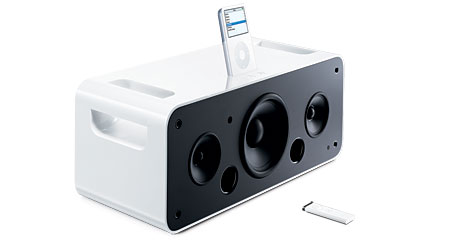
The iPod Hi-Fi, image copyright Apple Computer

This is Apple's new iPod Hi-Fi. Say hello to the boys and girls, Hi-Fi.
Where is this thing taking us anyway?

After meeting with a less than warm reception the next morning, the initial reviews of Apple's audio lifestyle accessory have started to come in, and they're pretty favorable. This PC Magazine review speaks pretty highly of the Hi-Fi's capabilities. Well, sure. Apple hasn't released any true stinkers in the last several years, regardless of your stance on the Cube PowerMac. First generation quirks aside, Apple employs talented engineers and developers, and their products can usually be counted on to perform decently well. Thankfully the days of things like flaming batteries seem to be behind us. In spite of Steve's hubris-tempting claims of audiophile-quality sound, I was confident that since Apple had actually decided to make a boom box, it would sound pretty good.

The question is, why did Apple decide to make one, and who is it for?

The product unveiling and subsequent media demonstration seems to position the iPod Hi-Fi squarely against the bookshelf stereo, friend to college students and apartment dwellers everywhere. With a list price of $350US, though, Apple has priced the Hi-Fi right out of the reach of the budget-conscious, especially when one can arrange iPod play-through on most $99 bookshelf units with the addition of an inexpensive cable. Many people will say this just another instance of Apple doing what they always do: running an average product through their style and marketing machine, and slapping on a twenty percent price mark up over their competitors. In this case, I'm not sure that I can disagree with them.

There are several other iPod speaker units on the market, made by a whole host of different companies. In fact, an entire eco-system of accessories has sprung up around the iPod since its introduction. A glance at Apple's online store lists 38 different types of speakers alone. Given the bio-diversity of such a market, then, I think we can say that Apple is positioning itself as the 'premium' iPod accessory manufacturer. There's room for everybody, but the Apple-branded iPod accessories will be the creme de la creme, and priced accordingly.

iPodGarage supposes that Apple's expanding iPod accessory offerings are a growth investment in the iPod aftermarket, and that
"...as it appears now, Apple's primary goal in launching the iPod Hi Fi is to send all forty million iPod users to the store in search of an iPod-specific speaker system of some kind. And as long as you go home with one, Apple doesn't much care which one you go home with."
This just isn't borne out by our past experience with Apple. The company learned its cautionary lesson during the 90's to never again make the mistake of spending production dollars on an item that can't sell on its own merits. I think what we have here is a case of Apple seeing a market and deciding that they can serve that market better than anyone else. Why this market though? How did Apple end up making boom boxes and cases for the iPod anyway?

Anyone who has followed Apple for the last few years doesn't need the recap, but in most estimations, the iPod kept the company's head above water when computer sales were slackening. It wasn't the first digital audio player, but it became the strongest thanks to Apple's designers and marketing pros. At the launch, Apple fans took the iPod to be a smart move in support of the core computing and software business. An iPod is useless without a computer to connect it to, and the components that one would need to make a DAP are available from the same channel partners that supply Apple's computer components. "Synergies!" we all whispered under our breath. The moment Apple's annual reports began to mention the 'halo effect' of iPods driving the sales of personal computers has become the point at which the tide turned. The iPod brand is now the strongest that Apple has to offer and sales revenues for the player lead all other Apple products every year. With the success of the iPod, Apple has started to resemble a consumer electronics company more and more, and maybe this has become the goal.

Apple dominates the DAP market, arguably the most lucrative consumer electronics prize around, and a market that was Sony's to lose after their dominance with the Walkman and Discman. With a Mac mini and an Airport Express, Apple seems to be making an ever stronger play to be taken out of the home office and into the entertainment center. We were introduced to the idea of the digital hub a few years ago, and at that point it was kind of an amorphous concept, not really anything more than a few pieces of clip art in a PowerPoint slide. I submit that Apple has decided that rather than have your Mac be your digital hub, they are positioning Apple itself as your digital hub, providing content and consumer electronic devices and accessories for everything, from one's desktop to the television, all the way to the street. Whether or not this is borne out remains to be seen, but it's clear that Apple stopped being solely a computer company long ago. Now, we're just waiting to see what they are.